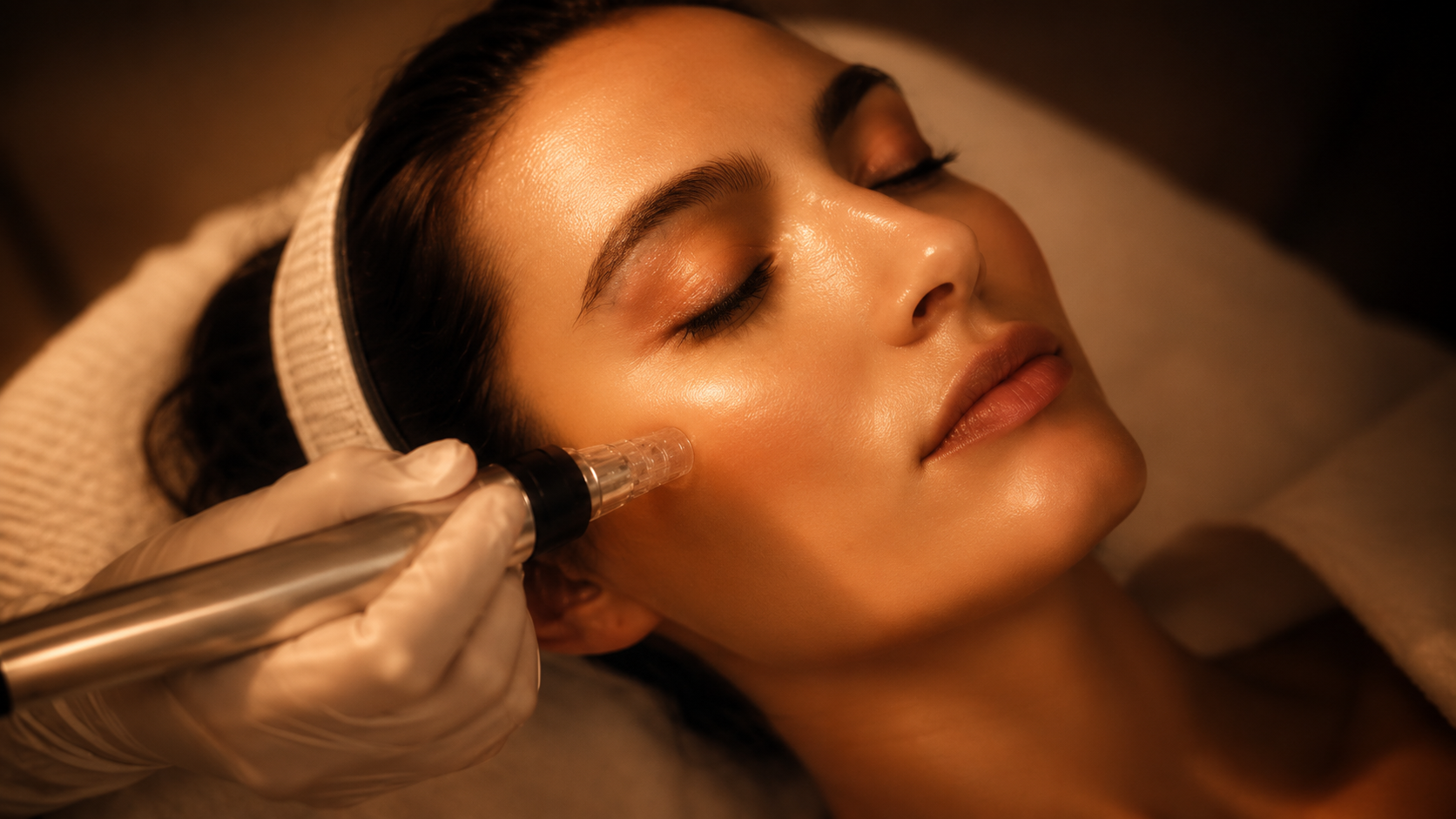
Your skin is far better at healing itself than you’d think — it just needs a reason to start. That’s exactly what this treatment gives it.
Using ultra-fine medical needles, we create hundreds of tiny, precise micro-injuries across the skin — controlled just enough to trigger your body’s own repair response, without any real damage. Your skin reads this as a signal to spring into action.
That signal goes straight to your fibroblasts — the cells responsible for producing collagen and elastin — and switches them back into building mode. Over the following weeks, this shows up as skin that’s visibly firmer, smoother, and structurally stronger, built entirely by your own regenerative process.
There’s also a bonus window most people don’t know about: for a short time after treatment, those micro-channels stay open, giving us a rare opportunity to deliver regenerative products — growth factors, peptides, or exosomes — far deeper into the skin than they could ever reach on their own. It’s the difference between applying something to your skin and actually getting it where it can make a difference.
The result isn’t an artificial fix sitting on the surface. It’s your own skin, prompted to repair and rebuild itself — stronger, firmer, and more resilient than before.
Both treatments use fine needles to stimulate the skin’s natural regeneration, but they work in different ways and are suited for different skin conditions.
Microneedling works by creating controlled micro-injuries in the skin, which stimulate collagen production and improve skin texture and overall skin quality. It does not significantly tighten the skin, because it does not deliver additional energy into deeper tissues.
For this reason, microneedling is often more suitable for younger patients or early stages of skin ageing, when the goal is to improve skin texture, pores, or mild collagen decline, rather than to correct visible skin laxity.
Radiofrequency microneedling, on the other hand, combines microneedles with controlled radiofrequency energy delivered into the dermis. This energy heats the deeper layers of the skin, stimulating stronger collagen remodelling and gradual skin tightening, which makes it more suitable for patients with skin laxity or structural loss of firmness.
For more mature skin, traditional microneedling is often used as a supportive or maintenance treatment, rather than as the main regenerative procedure. It may also be combined with radiofrequency microneedling as part of a multimodal skin regeneration strategy, helping improve skin quality while stronger technologies address deeper structural changes.
During consultation, the most appropriate treatment is selected based on the skin condition, degree of ageing, and treatment goals.
Microneedling can improve skin texture, early collagen decline, and overall skin quality, particularly in younger patients or in the early stages of skin ageing.
However, when more significant structural changes develop — such as skin laxity, loss of density, or deeper ageing processes — microneedling alone may not be sufficient.
In these cases, it is often used as part of a combined regenerative approach, together with treatments such as radiofrequency microneedling, PRP, exosomes, or other regenerative therapies that can influence deeper skin structures.
This allows us to address both skin quality and deeper structural changes, creating more balanced and longer-lasting results.
Medical microneedling performed in a clinic uses professional sterile devices and controlled needle depths, allowing treatment to reach the dermal layer safely.
Home dermarollers typically penetrate only the very superficial skin layers and do not provide the same regenerative stimulation.
Yes. Microneedling is generally considered safe for most skin types and skin tones, including darker skin types.
Unlike some laser treatments, it carries a lower risk of pigmentation changes, which makes it suitable for a wide range of patients when performed by trained medical professionals.
Yes, microneedling can generally be performed throughout the year, including summer months.
However, proper sun protection is essential after treatment to protect the skin while it is regenerating.
Microneedling is commonly used to improve:
• fine lines and early signs of ageing
• uneven skin texture
• enlarged pores
• mild skin laxity
• acne scars
• dull or tired-looking skin
It works by stimulating the skin’s natural regenerative processes.
Some improvement in skin texture may be visible within 1–2 weeks, but collagen production is a gradual biological process.
More noticeable improvements in skin quality typically develop over 4–8 weeks, with continued improvement after each treatment session.