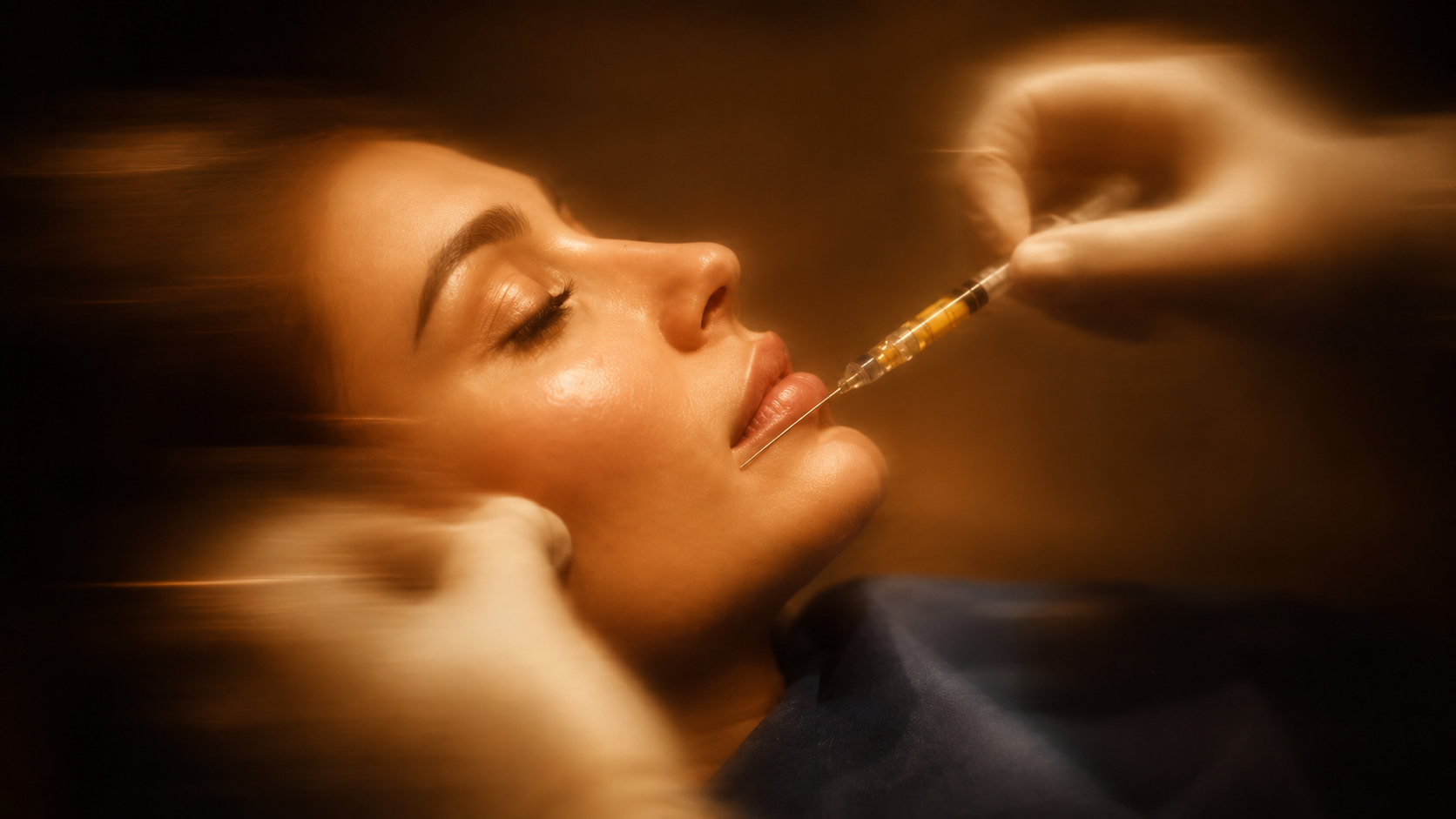
This is a minimally invasive surgical procedure, performed under local anaesthesia with sedation or general anaesthesia, depending on your treatment plan. This treatment is carried out at our partner clinic under referral.
We begin by gently harvesting fat from a donor area — commonly the abdomen or thighs — using a liposuction technique, then carefully purify it to isolate the healthiest fat cells. Using fine cannulas, this purified fat is then strategically placed within precise tissue layers of the face, hands, or body, allowing it to integrate naturally and deliver smooth, balanced, long-lasting results.
In selected areas, we also use a more refined version called nanofat — processed to a finer consistency and injected more superficially, where it works less on volume and more directly on skin quality, texture, and regeneration. Combining both approaches in the same session means we’re not just restoring what’s been lost — we’re rebuilding structure and rejuvenating skin at the same time.
Precise placement is what makes the difference between a result that looks “done” and one that simply looks like you, only rested. Our background in plastic surgery and detailed anatomical training means we place fat exactly within the tissue layers where it belongs — not just restoring volume, but genuinely improving tissue quality, for results that look natural because, structurally, they are.
Fat transfer may be suitable for patients experiencing:
• moderate to significant volume loss
• facial hollowing and contour changes
• body contour irregularities
• ageing changes in the hands
• preference for a natural, long-lasting autologous solution
A portion of the transferred fat integrates with the surrounding tissue and becomes long-lasting.
Some volume reduction may occur during the initial healing phase, after which the remaining fat typically provides stable, long-term results, often lasting for many years.
Yes. Fat transfer is a surgical procedure and is typically performed under local anaesthesia with sedation or general anaesthesia, depending on the treatment plan and patient preference.
Yes. Fat transfer is often combined, including during the same procedure, with:
• nano-fat for skin quality improvement
• microneedling with stem cell solutions
• laser treatments for skin resurfacing and tightening
• blepharoplasty (eyelid surgery)
• facelift and other surgical procedures
This combined approach helps address both structural volume loss and skin quality, supporting more comprehensive and long-term rejuvenation.
Different treatments can be used to restore volume loss, but they work in fundamentally different ways.
Fat Transfer (Fat Grafting)
Best for: moderate to significant volume loss and structural restoration
• Surgical procedure using the patient’s own fat
• Provides structural, long-lasting volume
• Contains regenerative cells, including stem cells
• Can improve both volume and skin quality over time
• Requires anaesthesia and involves longer recovery
Fat transfer is typically chosen when deeper, more significant correction is needed.
Plasma Bio-Filler
Best for: mild to moderate volume loss and regenerative improvement
• Minimally invasive treatment using plasma-derived autologous filler
• Provides subtle, natural-looking volume restoration
• Supports tissue regeneration and skin quality through growth factors
• Minimal downtime
• Results are temporary and gradually resorbed
Plasma Bio-Filler is often chosen by patients seeking a natural, lower-risk alternative to synthetic fillers or as a step before surgical options.
Dermal Fillers (Hyaluronic Acid)
Best for: quick volume correction and contouring
• Non-surgical, widely used treatment
• Provides immediate volume and contour definition
• Results are temporary
However, in some cases, synthetic fillers may be associated with risks such as:
• persistent swelling
• migration of filler
• irregular contours or visibility under thin skin
• inflammatory reactions or vascular complications
Our Perspective
At YURON, treatment selection is based on the degree of volume loss, tissue quality and long-term goals.
Where appropriate, we prioritise autologous and regenerative approaches, as they allow us to not only restore volume but also support biological tissue health and more natural ageing outcomes.